Brass Feeler Gauge, 0.05 to 1.0 mm Blades, T2 | HOLEX
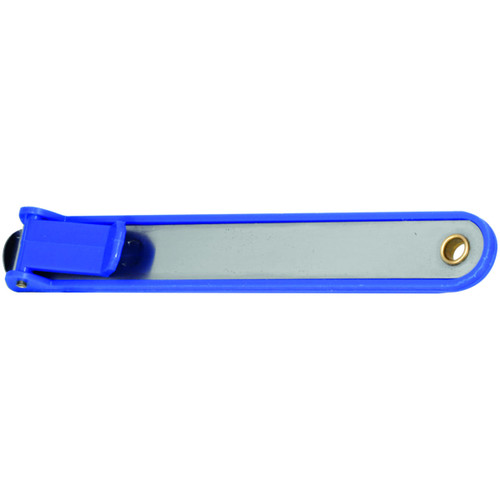
This HOLEX brass feeler gauge reads small clearances on magnet-sensitive assemblies, a non-magnetic thickness gauge for machine setup, mold and die alignment, electrical assemblies, and maintenance inspections. Each blade in the set measures 100 mm (3.9 in.) long and 12 mm (0.5 in.) across at its widest point.
Blade thicknesses run from 0.05 to 1.0 mm in 0.05 mm increments, which makes this a metric feeler gauge with fine steps across the whole range. Thickness tolerance is class T2 to a works standard. The blades swing out on a riveted joint, then fold flat again between checks. Because the blades are brass rather than steel, they stay non-magnetic around sensors, magnetic chucks, and instrument work.
Key features:
• Tapered blade form: the tapered feeler gauge profile enters narrow gaps without forcing
• Clear size labelling: each blade carries an easy-to-read thickness marking for fast selection
• Nickel-plated casing with clamp: protects the folded blades between inspections
• 20 blades in the set: the only blade count offered in this brass version, so the whole thickness range comes in one gauge
Where does a brass blade earn its place in gap checks?
Brass blades check gap widths on magnet-sensitive assemblies by feel, giving maintenance and setup work a reading no rule or caliper can reach.
Applications: valve clearance checks, machine gib adjustment, mold and die spotting, bearing end play verification, electrical contact gaps, flatness checks under a straightedge.
Industries: precision machining, tool and die, automotive service, electronics assembly, general maintenance and repair.
Users: machinists, toolmakers, maintenance technicians, quality inspectors.
How much drag on the blade means you have the right size?
A light, even drag is the signal. Work up through the marked thicknesses until one blade passes through the clearance with that feel, and that blade's marking is your measurement. A feeler gauge reads the width of a narrow gap by feel. Stack two blades when a gap falls between single sizes, and wipe the blades clean before and after each check.
Which gap gauge sizes does this set cover?
Blades step by 0.05 mm from 0.05 up to 1.0 mm, spacing fine enough to bracket most clearance specs without stacking. The blades are sized on the metric scale, so if your spec sheet reads in thousandths of an inch, convert it to millimeters before you measure.
Do feeler gauges in brass behave differently from steel ones?
Yes, in one important way. Brass blades stay non-magnetic, so they suit checks near sensors, magnetic chucks, and electronic assemblies where steel is unwelcome. Handle them with the same care you would give any precision gauge, and keep the blades clean and dry so the measuring faces stay accurate.
|
ESD protected area (EPA) |
no |
|
Min. thickness |
0.05 mm |
|
Max. thickness |
1 mm |
|
Thickness tolerance class (accuracy) |
T2 |
|
Blade length |
100 mm |
|
Number of blades |
20 pcs. |
|
Configurable |
no |
|
Blade thicknesses |
0.05 mm; 0.1 mm; 0.15 mm; 0.2 mm; 0.25 mm; 0.3 mm; 0.35 mm; 0.4 mm; 0.45 mm; 0.5 mm; 0.55 mm; 0.6 mm; 0.65 mm; 0.7 mm; 0.75 mm; 0.8 mm; 0.85 mm; 0.9 mm; 0.95 mm; 1 mm |
|
Type of product |
feeler gauge |
|
Overall length L |
100 mm |
|
Content |
single part |
|
Standard |
works standard |
|
Material |
brass |
|
Article number |
478210 20 |
|
EAN / GTIN |
4045197207494 |
|
Manufacturer number |
478210 20 |
|
Manufacturer/responsible person |
Hoffmann Supply Chain GmbH & Co. KG, Poststraße 15, 90471 Nürnberg, Germany |