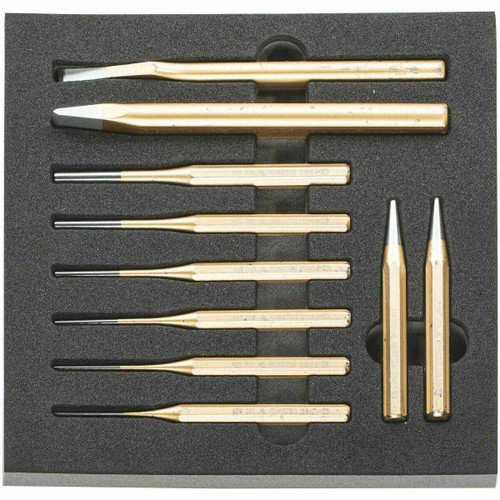
The Rennsteig drive pin punch drives dowel pins and roll pins out of their bores, a parallel pin punch in chrome vanadium air hardening steel, 150 mm (5.9 in.) long overall. Machine shops reach for it during builds, assembly stations during fit-up, and maintenance bays during teardown. Each size is a pin punch tool you stock individually, so your drawer holds exactly the diameters your work uses.
Six point diameters are available, from 2 mm (0.1 in.) to 8 mm (0.3 in.), each built on a sturdy octagonal shank with a cylindrical shaft. The actual point runs 0.05 to 0.5 mm under its nominal diameter, a deliberate allowance that keeps the punch from jamming in the hole as the pin moves. Sizing follows DIN 6450 C, and every punch is safety tested to DIN 7255.
Key features:
• Uniformly through hardened over the entire length: consistent hardness from point to head for a long working life
• Specially annealed head: prevents splintering under hammer blows
• Painted surface finish: guards the steel between uses
How does a drive punch push a stuck pin out cleanly?
A drive punch pushes a pin through its bore with square hammer blows on the punch head, keeping force on the pin instead of the surrounding part.
Applications: removing dowel pins, driving roll and spring pins, freeing hinge pins, shifting clevis pins, backing out small rivets, general pin fitting and removal.
Industries: automotive repair, agricultural machinery service, machine building, metal fabrication, equipment maintenance.
Users: machinists, maintenance mechanics, automotive technicians, assemblers.
Why does a pin punch point measure under the pin diameter?
A point a shade under the pin diameter travels with the pin instead of wedging against the bore wall. That clearance is why a pin punch, a striking tool with a straight parallel tip, can follow a pin the whole way out of its bore or drive a fresh one in. Reach for one after a starter punch has broken the pin loose, and let the parallel tip carry it clear.
Do you need a whole pin punch set for occasional work?
Not necessarily. Each point diameter here is ordered on its own, so occasional work does not have to begin with a full pin punch set. Check the pins in your machines first, buy the two or three diameters that match, and add another of these Rennsteig pin punches the day a different pin size appears. That keeps the spend proportional to the pins you actually handle.
Why is the punch head annealed instead of hardened?
The struck end is specially annealed, which leaves it tough enough to absorb hammer blows without splintering into sharp fragments. A fully hardened head could chip at the edges, so this dedicated head treatment protects both your eyes and the work. Dress a mushroomed head on a grinder before it spreads, whatever punch you use.
Standard
DIN 6450.
Safety tested to DIN 7255.
|
Diameter of tip |
2 mm |
3 mm |
4 mm |
5 mm |
6 mm |
8 mm |
|
Overall length L1 |
150 mm |
150 mm |
150 mm |
150 mm |
150 mm |
150 mm |
|
Mandrel length L2 |
30 mm |
40 mm |
50 mm |
50 mm |
50 mm |
50 mm |
|
Shank S |
10 mm |
10 mm |
10 mm |
10 mm |
10 mm |
12 mm |
|
Article number |
747000 2 |
747000 3 |
747000 4 |
747000 5 |
747000 6 |
747000 8 |
|
EAN / GTIN |
4049002002786 |
4049002002809 |
4049002002823 |
4049002002847 |
4049002002854 |
4049002002878 |
|
Manufacturer number |
450 002 0 |
450 003 0 |
450 004 0 |
450 005 0 |
450 006 0 |
450 008 0 |
|
Standard |
DIN 6450 C |
|||||
|
Material |
Chrome vanadium air hardening steel |
|||||
|
Surface |
painted |
|||||
|
Type of product |
Parallel pin punches |
|||||